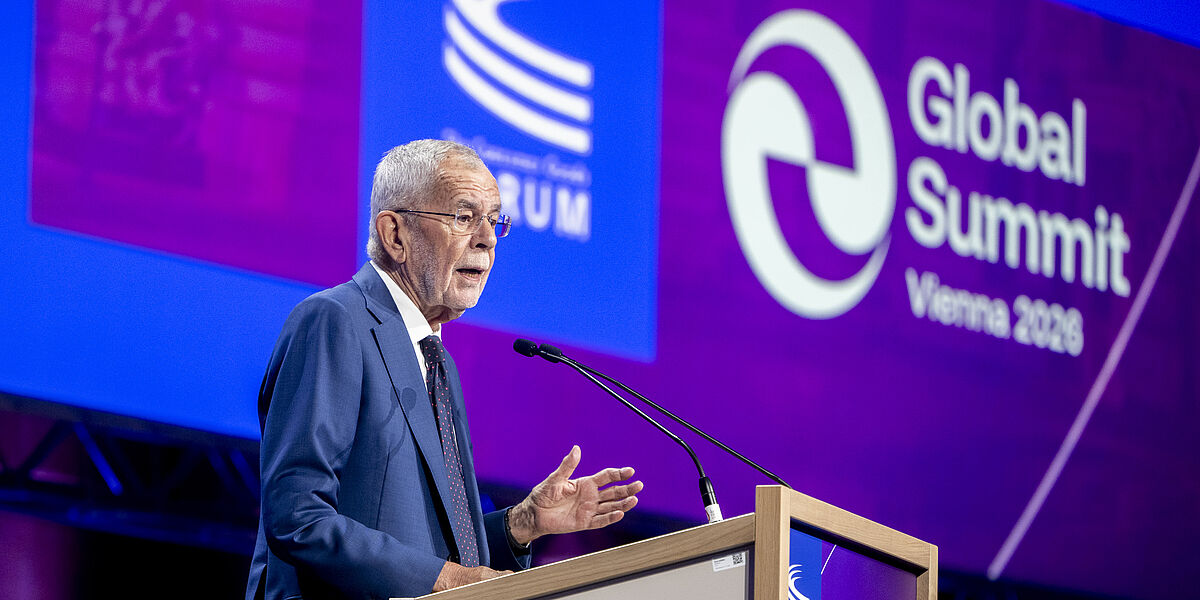
Rede von Bundespräsident Alexander Van der Bellen für den Consumer Goods Forum Global Summit.
Ladies and Gentlemen!
When I look around this room, I see people who know their business. People with great power and influence. And a vast range of responsibilities.
But I also see a room full of rivals.
You are competing for customers, competing for markets, competing for the top spot in the shelf – maybe for the same hotel room here in Vienna during this summit.
And yet: You are here. In the same room. Agreeing on shared rules, shared standards – A shared future.
You might be thinking: Right from “shared standards” to a “shared future”? Seriously? Isn’t that a bit of a stretch?
Well: When a shipping container leaves Shanghai, it fits on a truck in Hamburg. Because someone, somewhere, decided that the dimensions of this huge metal box should be the same everywhere.
The same goes for that famous striped rectangle which you find on virtually every product you buy.
Half a century ago, competitors came together – just like you do today. They exchanged arguments, pushed back and forth. But in the end, they put aside their differences. They shook hands and agreed upon using a standardized barcode system.
It’s a bit lazy thinking that shared rules are just bureaucracy. Or an inconvenient barrier to illegal collusion. But that’s not what I have in mind, of course.
I am talking about solutions that work for everyone, not for those who try to manipulate the market. As trivial as something like a barcode seems:
Shared standards mean security. Predictability. And if something is secure and predictable, companies can invest. Investment, in turn, creates jobs. And prosperity.
But: Shared rules are not easy to agree on. That is something of an understatement when your negotiating partner is also the person trying to take your market share.
Look at the person sitting next to you. Chance is, at some point, you've paid someone specifically to figure out how to outperform them. But today you’ll be having lunch together.
Why? Because you recognised – rightly – that some problems are too large for any one company to solve alone.
We need each other. Whether it’s coalition governments, alliances of states or a small striped rectangle: They are built on compromise.
Someone who divides the world into "friend or foe”, into “winner or loser” is incapable of such a compromise. Because life is not a football match. Or an MMA fight on the White House lawn.
Yet, we live in a moment where tariffs are called “the most beautiful word in the dictionary.” Where trade wars are declared “good, and easy to win.” Where duties are calculated by a method that has puzzled every economist who has tried to reverse-engineer it.
Without rhyme or reason, without shared rules, you know what we get? Chaos. And you cannot build prosperity on chaos. You cannot build trade partnerships on chaos. You cannot build a future on chaos. At least not a good one.
There is a theory that some philosophers and economists proposed and history (mostly) confirmed: When goods don’t cross borders, armies will.
That is why trade is way more than business: It connects us. Across borders, across belief systems, across political views. It makes peace and cooperation profitable for both sides.
Think back to the founding of the European Union: Germany and France had been embroiled in wars time and time again. Until they shared steel production.
Why am I telling you all of this? You represent a significant share of global consumer goods trade. That means: you wield a similar rule-making power as most governments currently have.
Companies like yours, in rooms like this one can make a difference. Whether it’s a metal box. A striped rectangle. A polio vaccine. An ozone treaty. Or even a space station.
Divided there is little we can do. United there is little we cannot do.
They all happened because people like you – with contrasting interests – decided that a shared solution was better than competing chaos.
Imagine what else you can make happen. Like, let’s say: Saving our planet. Your products are in every room of every home on earth. From the toothbrush we use in the morning to the light we switch off at night.
If you agree to move on climate – together –the market moves with you. And, ultimately, the world moves with you.
That is why it’s not that big of a stretch from “shared standards” to a “shared future”.
Let me close with – loosely – quoting a famous president of the US back when presidents of the US were still quotable: “Divided there is little we can do. United there is little we cannot do.”
Thank you.