Ladies and Gentlemen,
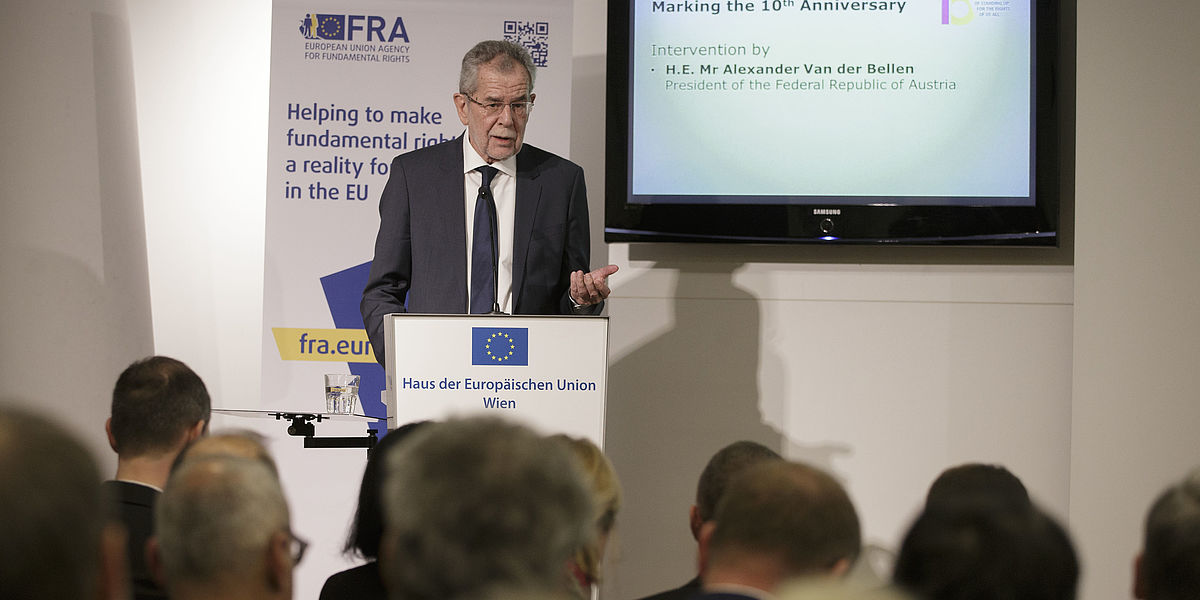
it is my great pleasure to speak here today and welcome you to Vienna to celebrate a very special occasion. 10 years ago, almost exactly on the same day, namely the 1st of March 2007, the Fundamental Rights Agency was inaugurated. Austria has always been a very strong supporter of the Agency, not only because it is seated in Vienna, but also because we are convinced about the importance of such a “human rights competence centre” for the European Union.
Comparing the situation in the EU and the world today to that of 10 years ago, it seems however that these are not the times for human rights. A day does not go by without news reports of human rights violations in countries across all regions of the world: killings and displacement, disappearances and arbitrary detentions, repression of human rights activists and free media, violence against women and discrimination against minorities, racism, xenophobia and hate speech, in particular on the internet, human rights violations in the fight against terrorism and security measures, rising poverty and increased marginalisation, and of course the ongoing migration and refugee crisis.
Instead of increased responses and remedies to these human rights violations we witness increased polarisation and nationalism worldwide. We see state leaders focusing on local values instead of global ones, resolving conflicts through brute force rather than on the basis of international law, favouring authoritarianism and “strongman behaviour” over democratic pluralism and diversity. Human rights are being portrayed more and more as part of the problem instead of part of the solution.
I firmly believe in human rights being not only part of the solution but being the cornerstone of our identity, in particular for us in Europe. I believe more in building bridges than building walls. I believe that human rights, protected by the rule of law, are the fundamental building blocks of peaceful, open and inclusive societies. And as I have recently said during my visit in Strassburg, I believe in a Europe that with its law-based value system can continue to be an example for the whole world.
Ladies and Gentlemen,
Human rights are often seen as an abstract concept. But they are very concrete and real. They are what ordinary people all over the world in their daily live are striving for: to live a decent life free from fear and want. They want to satisfy their basic needs, such as food, housing, and education. They want to be protected against abuse by those who are more powerful and they want be free to express themselves and speak their mind.
So, in times when human rights disappear from public speeches, policy papers and government programs I believe it is important to focus on this core meaning of human rights. In times of polarisation human rights should be the unifying element for all people independent of their nationality, religion, skin colour or gender.
We need to focus on what we can achieve if we work together, in particularly within the European Union. And we need stakeholders, activists and institutions to push political decision-makers, provide expertise and most importantly help develop solutions and concrete ideas for action. These solutions must have a direct impact for people on the ground and be meaningful outside of the conference rooms, academic circles and dialogue platforms.
Ladies and Gentlemen,
As I have said at the beginning, Austria has always supported the foundation of the Fundamental Rights Agency as a human rights competence centre for the European Union. We were convinced about the need for a specialised, independent EU body providing expertise and advice, raising awareness but also acting as a public and critical voice in times of crisis. 10 years later let me congratulate you, Director O’Flaherty and all your staff, on the achievements made so far and the development the Agency has undergone over the years.
The Agency has grown into an indispensable element in the European human rights architecture. It assists and reminds the EU and its Member States to uphold their fundamental rights commitments. It conveys the message beyond the European borders, as recently even in Africa at the human rights dialogue between the EU and the African Union. And the multiple public speeches given by Director O’Flaherty in the last weeks and months prove its role as a critical voice in times of crises to be fulfilled as well.
I am convinced that over the next 10 years the work of the Agency will be even more indispensable. More than ever, we will need innovative ideas how to translate the laws, studies and policy recommendations on human rights into actions relevant for the people on the ground. We will need regular reminders to political leaders why we have to keep human rights on our agenda and work on its implementation. And we will need positive and optimistic voices for the future that encourage every single one of us to act, engage and stand up for human rights.
Because - as Holocaust survivor Elie Wiesel has said almost 20 years ago – “indifference, after all, is more dangerous than anger or hatred; it is not a beginning, it is an end. And, therefore, indifference is always the friend of the enemy, for it benefits the aggressor and never his victim”.
I am confident that in the end European solidarity will prevail over nationalistic tendencies, that our deep rooted common values as human beings will overcome polarisation, and that standing up for the “other” will win over indifference. Let us all contribute to this goal.
Thank you very much.